COLOR SCIENCE
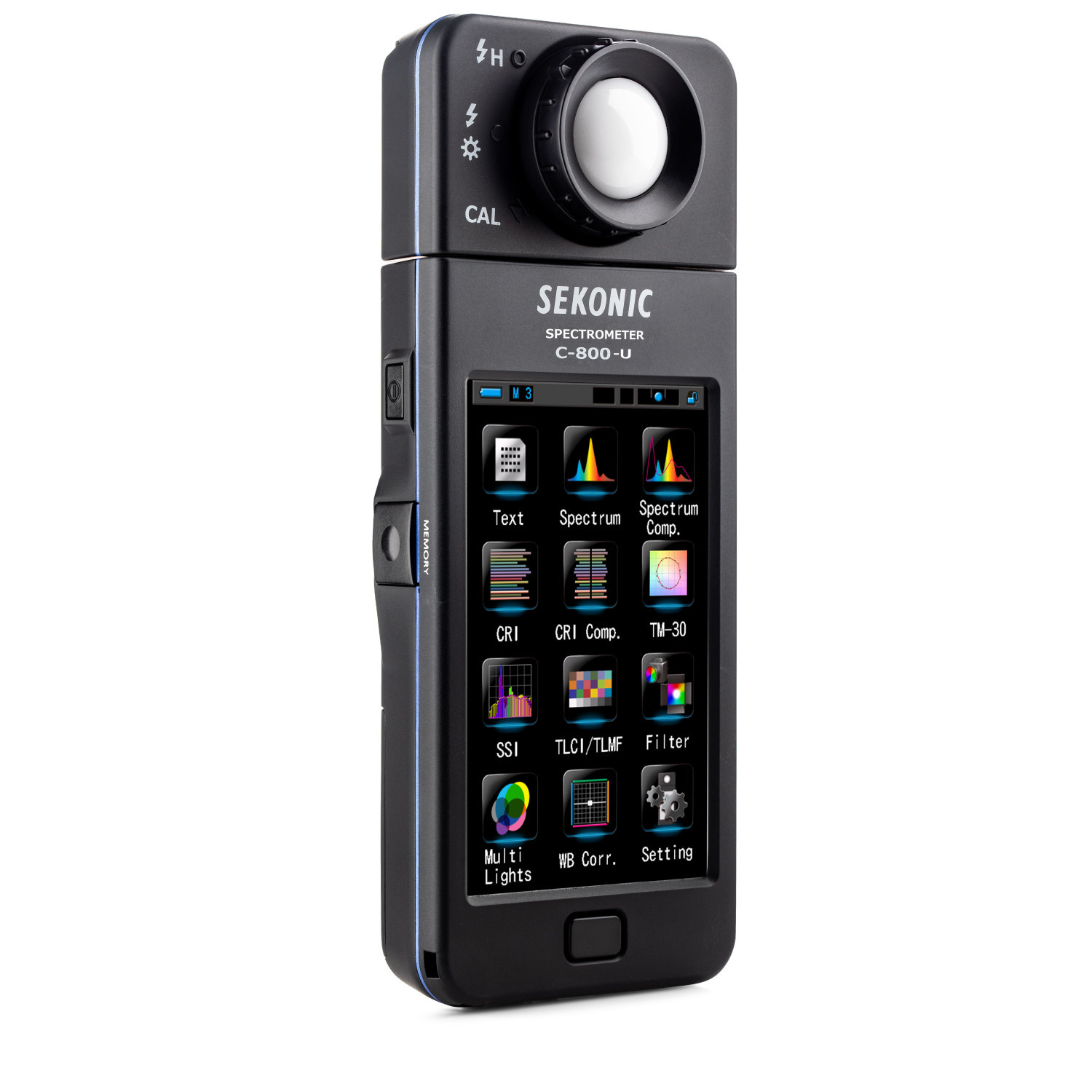
Sekonic C-800 Spectrometer
Single-phosphor blue-pump LED. Ra 82 looks “fine” on a box label, but R9 collapses, TLCI drops, reds crush on the vector, and SSI vs D65 warns you. Classic trap for faces and wardrobe.
Click MEASURE on the side of the meter — or tap the screen for modes.
Product images courtesy of Sekonic. Used with permission (Hitoshi Iyama).
This is a photo of the real C-800. Pick what you’re measuring, then click MEASURE on the image. A reading pops up — the way you’d use the meter on set.
DEEP DIVE
Observers: eye, camera, or spectrum+
CRI and TM-30 score with human vision as the observer. TLCI/TLMF use a model three-chip broadcast camera. SSI removes observer bias and compares SPDs directly. Pick the index that matches the risk you care about — skin for humans, live TV for TLCI, cross-fixture match for SSI/TLMF.
CRI — still useful, easy to game+
CRI was built around fluorescent lamps and eight muted samples for Ra. Image makers still use it as a quick filter (roughly 85–95 good, above 95 exceptional) but gaffers who trust it dig into R9, R13, and R15 for skin. High Ra with weak reds is a classic LED failure mode on faces.
TM-30 vector — the modern LED truth serum+
Ninety-nine samples, Rf + Rg, and a 16-bin hue vector. Black ring = reference saturation; red ring = your light; arrows = hue drift (e.g. green pulling blue). LEDs can post CRI 95+ while the vector shows oversaturated greens that fight camera matrices or LED-wall content. Prefer the vector over a single Ra when signing off a key light.
SSI — match the spectrum, not the sticker+
SSI bins the SPD and scores similarity to CIE standards, a Planckian/D-series synthetic, or a memorized hero. After gels fix CCT and Δuv, SSI still catches mismatches that show up on camera. Treat low SSI as an early warning you will not grade away easily.
Red Rock OPS field workflow+
1) Measure the hero key in Text + Spectrum. 2) Check TM-30 vector (Rf high, Rg near 100, red line close to black). 3) Score SSI and TLMF of every supporting fixture against that hero. 4) Inspect R9/R13/R15 or TLCI for the delivery path (cinema grade vs live). 5) Only then gel or spectrum-tune. 6) Confirm on the show camera and, for walls, against the processor’s color pipeline.
Metrics and mode behavior summarized from Sekonic C-800 documentation and training material. Always verify critical matches on the production camera.